
I don't always know what I'm going to paint when I start. Actually, sometimes I prefer it that way.
One of the ways I explore new ideas is through automatic drawing. It's a process that allows me to make marks without a predetermined image or composition in mind. I start drawing, see what happens, and respond to whatever shows up. It's a way of getting past the part of my brain that wants to figure everything out before I've even started.
And occasionally, something interesting happens.
What Is Automatic Drawing?
Automatic drawing is a technique where an artist allows the hand to move freely, making marks without consciously deciding what they should become. The idea is to let instinct and the subconscious influence the work rather than planning every line or shape.
That doesn't mean there's no decision-making involved. At least not for me. I might begin with a few spontaneous marks, then notice something worth exploring. Maybe it's an unexpected shape, an interesting relationship between two lines, or an area that needs absolutely nothing else.
That's when the process becomes a back-and-forth between intuition and intention. I don't necessarily give up control. I just try not to take control too early.
A Brief History of Automatic Drawing
Automatic drawing has a surprisingly interesting history, and it was being practiced well before the Abstract Expressionists came along.
In 1896, Swedish artist Hilma af Klint formed a spiritualist group with four other women called The Five. They experimented with automatic drawing during séances, believing their hands were being guided by spiritual forces. Af Klint later became one of the pioneers of abstract painting.
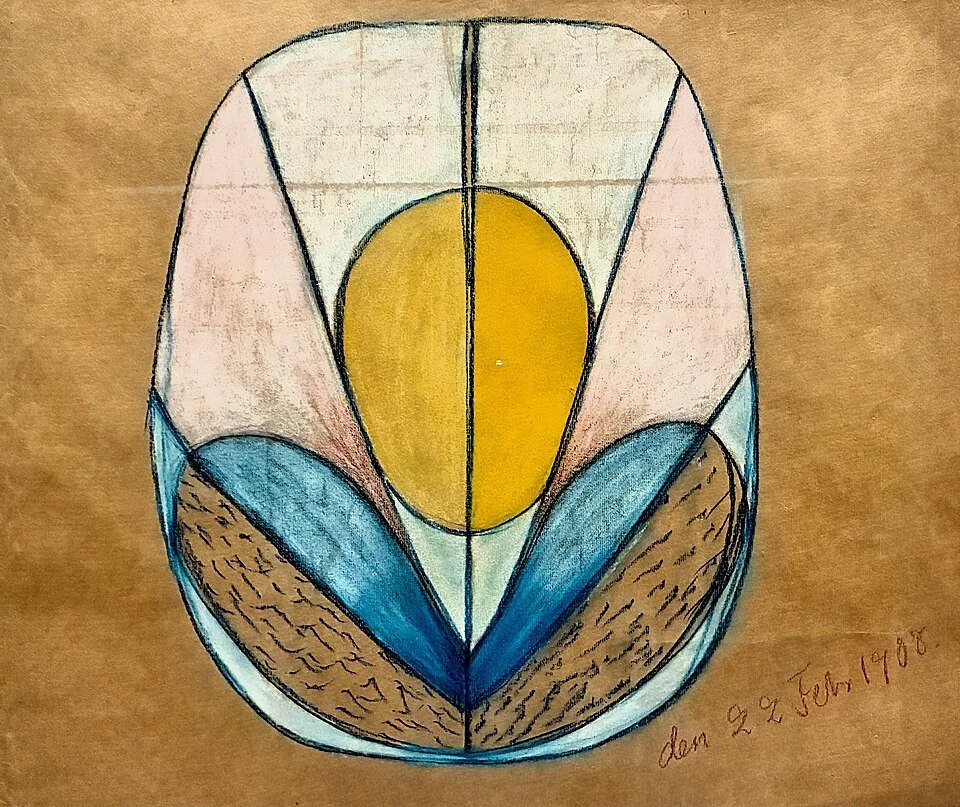
The Five, Untitled, 1908. Automatic drawing associated with Hilma af Klint's spiritualist group.
By the 1920s, the Surrealists were exploring similar techniques for different reasons. André Breton helped establish the movement, while artists like André Masson used automatic drawing to explore the unconscious mind rather than communicate with spirits.
The approach eventually influenced American Abstract Expressionism, including Robert Motherwell, who adopted Surrealist automatism as a way of developing compositions through spontaneous drawing.
And then there's Franz Kline. Although his approach wasn't strictly automatic drawing, he often developed enormous abstract paintings from surprisingly small sketches. Some were originally drawn on pages from telephone books.
I can certainly relate to that last part. Not the telephone books, but the small drawings becoming something much larger.
From a Three-Inch Sketch to a Five-Foot Painting
I often begin with thumbnail sketches, sometimes no larger than three inches. At that scale, I'm not particularly concerned with making a finished composition. I'm experimenting with marks, shapes, open space, and the relationships between them.
Most of those sketches remain just that—experiments. But occasionally, one stands out. It might be a shape I hadn't intended to make or a composition that feels interesting for reasons I can't immediately explain. Those are the ones I sometimes return to when developing a larger painting.
And by larger, I mean considerably larger. Something that began as a three-inch drawing might eventually become a four- or five-foot painting.
I'm not interested in simply copying the sketch at a larger scale. The original idea gives me somewhere to begin, but the painting develops its own character as I work through it. Something that feels perfectly balanced at three inches can behave very differently when it's five feet wide.
That's part of the fun.
Small Works That Stand on Their Own
Not every small study needs to become something larger. Sometimes the original marks, shapes, and composition are enough. There's no reason to keep developing an idea simply because there's more room to work.
That's part of what I enjoy about creating small original paintings. They give me the freedom to experiment without feeling that every idea needs to become some grand statement.
My Trio Studies grew out of that approach. Each set brings together three individual 4 × 4-inch original abstract paintings, framed as a small collection. They're related to the same kind of exploration that informs my larger paintings, but each is a finished piece in its own right.
Small doesn't necessarily mean preliminary. Sometimes a painting says everything it needs to say in four inches.
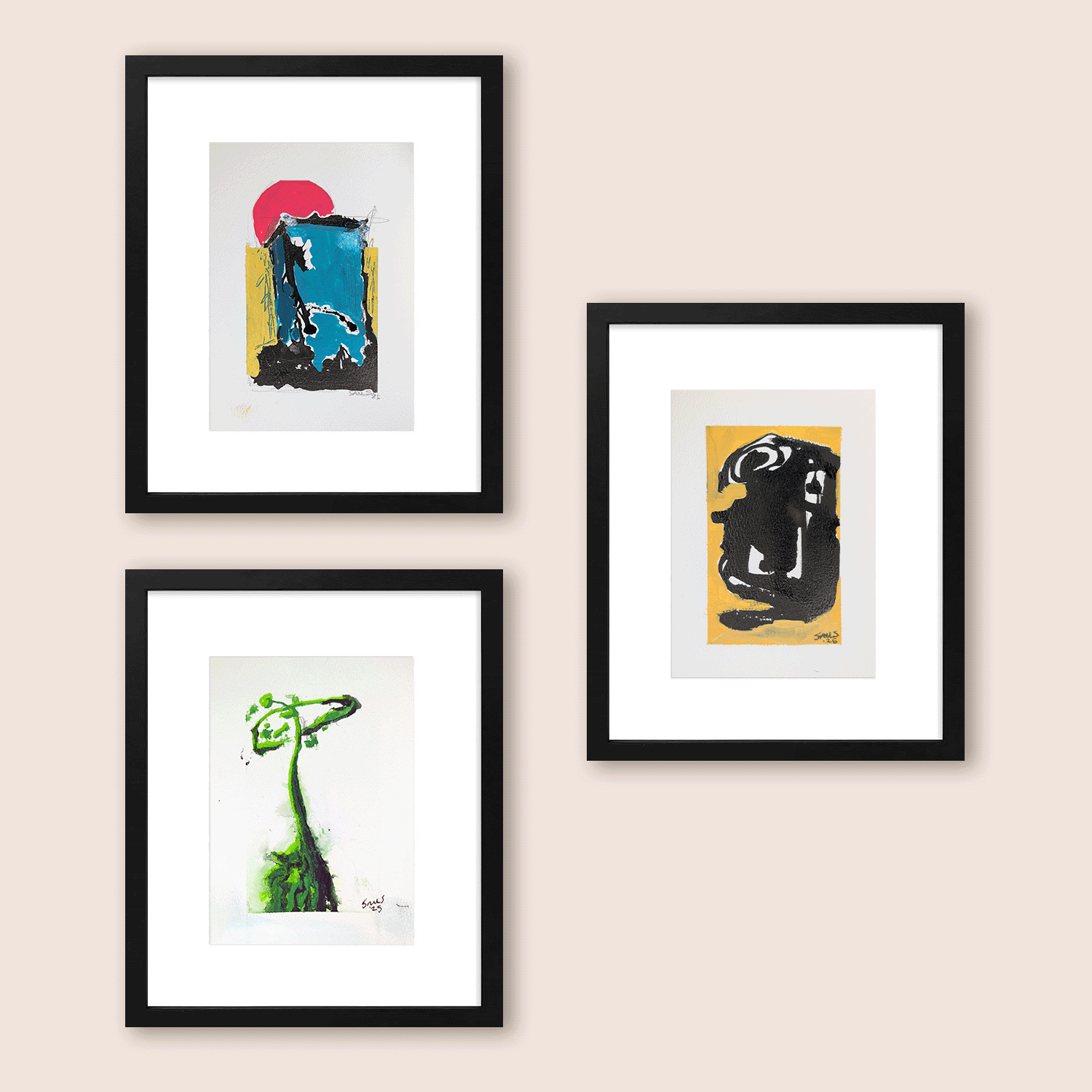
Trio Studies by Dean Sauls. Three original 4 × 4-inch abstract paintings, individually framed and available as a set.
Leaving Room for the Unexpected
Automatic drawing doesn't guarantee that something interesting will happen. I've certainly made plenty of marks that went absolutely nowhere. But that's okay.
What keeps me coming back is the possibility of discovering something I wouldn't have thought to plan. Sometimes it's just a little drawing that I like. Other times, it's the beginning of something much bigger.
Either way, I'm still curious to see where it goes.
