

Small paintings don't usually shout across a room. They invite you to come closer, and that's one of the things I love about them.
A painting can be just four inches square and still have a lot going on. Color, composition, a little tension, and those tiny details that seem to reveal themselves the longer you look.
I'm drawn to familiar subjects—fruit, flowers, marbles, and the occasional item that might otherwise have been headed for lunch. There's something satisfying about taking an ordinary object out of its usual context and giving it your complete attention.
A Small Painting Is Still a Complete Painting
Working on a small canvas doesn't mean thinking smaller.
In fact, when there's less space to work with, every decision becomes more noticeable. The position of an object, the color surrounding it, the distance between two shapes, or even a small patch of empty space can change the feeling of an entire composition.
I enjoy seeing how much personality a simple subject can have when it's given a little room to be itself.
A small original painting doesn't need to be a study for something larger. It can stand entirely on its own.
The Ordinary Has Plenty of Personality
One of my favorite things about still life is that the subject doesn't have to be particularly important.
A few blueberries can be interesting. So can a flower, a piece of fruit, or a handful of marbles.
In Blueberries on Orange, four little blueberries sit against a bright orange background. The subject is simple, but the relationship between those cool blues and the warm orange gives the painting its energy.
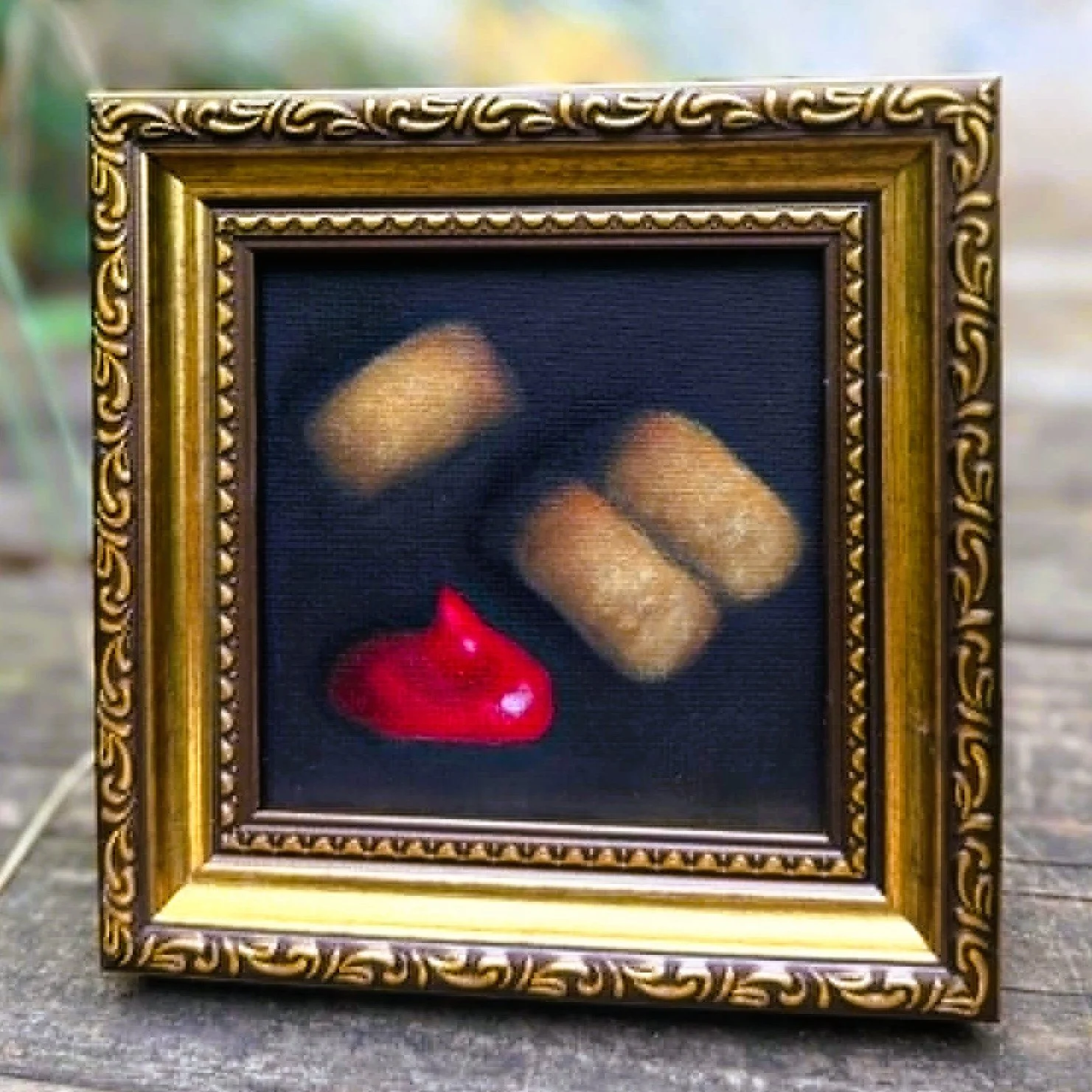
And then there's Tiny Tots, a painting of three golden tater tots with ketchup.
Yes, tater tots.
Still life doesn't require a fancy subject. Luckily for the tater tots.
I like that a familiar object can become something a little unexpected when you change its surroundings. Sometimes the result is quiet and thoughtful. Sometimes it's playful. Both are interesting to me.
The Pleasure of Looking Closely
Original paintings have qualities that aren't always easy to appreciate on a screen.
There's the surface of the paint, the edges of the brushstrokes, subtle shifts in color, and the way light changes what you notice.
With smaller works, you naturally find yourself looking more closely. You aren't taking in the painting from across a large room. You're noticing the relationships between shapes and colors, the marks, and the little things that give the work its character.
That's part of the pleasure of living with original art.
A painting doesn't have to reveal everything in the first few seconds. Sometimes the details you discover later become the ones you enjoy most.
Choosing a Small Original Still-Life Painting
If you're considering adding a small painting to your collection, I think the most important question is whether it keeps your attention.
Maybe it's the color that draws you in. Maybe it's a familiar subject presented in a way you hadn't considered before. Or maybe something about the composition simply makes you happy.
There doesn't always have to be a complicated reason.
Of course, practical details matter, too. It's worth knowing the painting's actual dimensions, medium, and whether it's framed or unframed. Those details help you understand the work you're collecting.
But I wouldn't choose a painting simply because it fits a particular spot.
Choose something you enjoy looking at. Something that feels personal to you.
A small painting can become a meaningful part of a collection without needing to dominate a wall or make a grand announcement.
A Little More Attention to the Everyday
I think that's what continues to interest me about still life.
There are wonderful shapes, colors, and relationships hiding in things we see every day. Sometimes all it takes is separating an object from its usual surroundings to notice them.
And if a tiny painting of blueberries—or even a few tater tots—makes someone pause, look a little longer, and smile, I'm pretty happy with that.
— Tricia Sauls
